unknown
What Are Frederic Church’s Stunning Landscapes Trying to Tell Us?
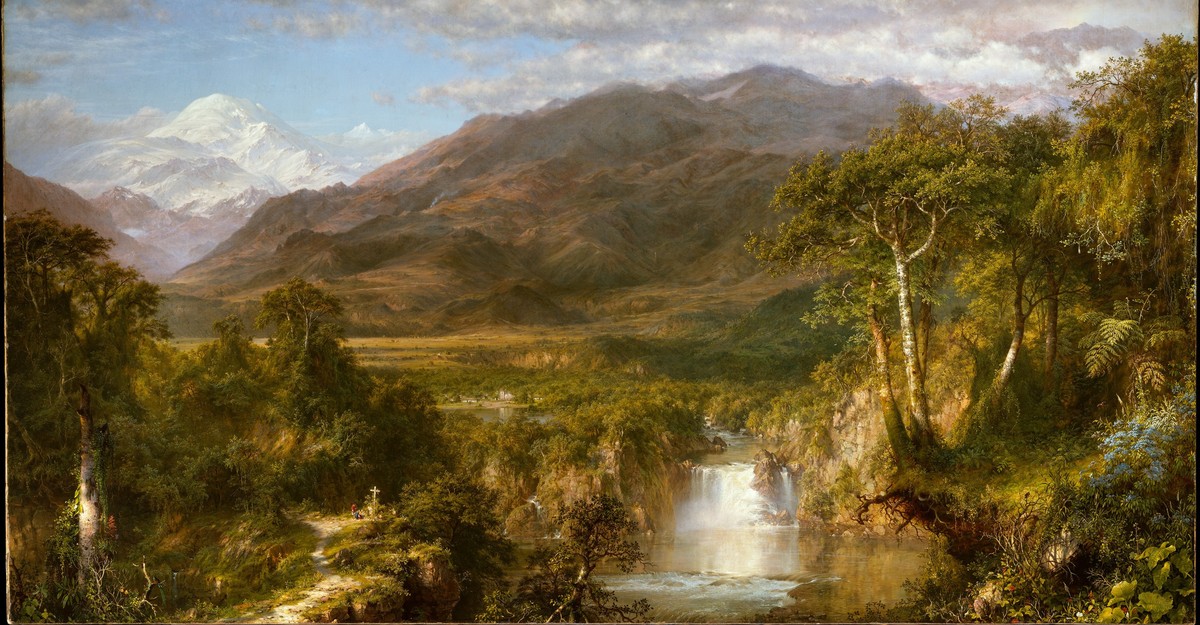
“We know of nothing,” Henry James observed in 1875, “that is a better proof of the essential impotence of criticism, in the last resort, than Mr. Church’s pictures.” James wasn’t (in this instance) being spiteful. He was trying to sort out a real problem: What did the work of America’s preeminent painter actually mean? Serious art is supposed to mean something—that’s a given—but really, what is there to say about Frederic Church’s Valley of Santa Ysabel, New Granada? You see distant mountains, an effulgent sky reflected in placid water, lots of greenery, and tiny people not doing much besides establishing the scale of an adjacent palm. You can feel the stillness and weight of the air. “Why not accept this lovely tropic scene as a very pretty picture,” James asked, “and have done with it?” A century and a half later, we’re still stumped.
TL;DR
- Henry James found it difficult to interpret Frederic Church's paintings in 1875.
- The meaning of Church's preeminent American painter works remained a problem for critics.
- Paintings like "Valley of Santa Ysabel, New Granada" feature landscapes with distant mountains, reflective water, and greenery, with small human figures.
- The stillness and atmosphere of the scenes are palpable, but their deeper meaning is unclear.
- The challenge of understanding Church's art persists more than 150 years later.