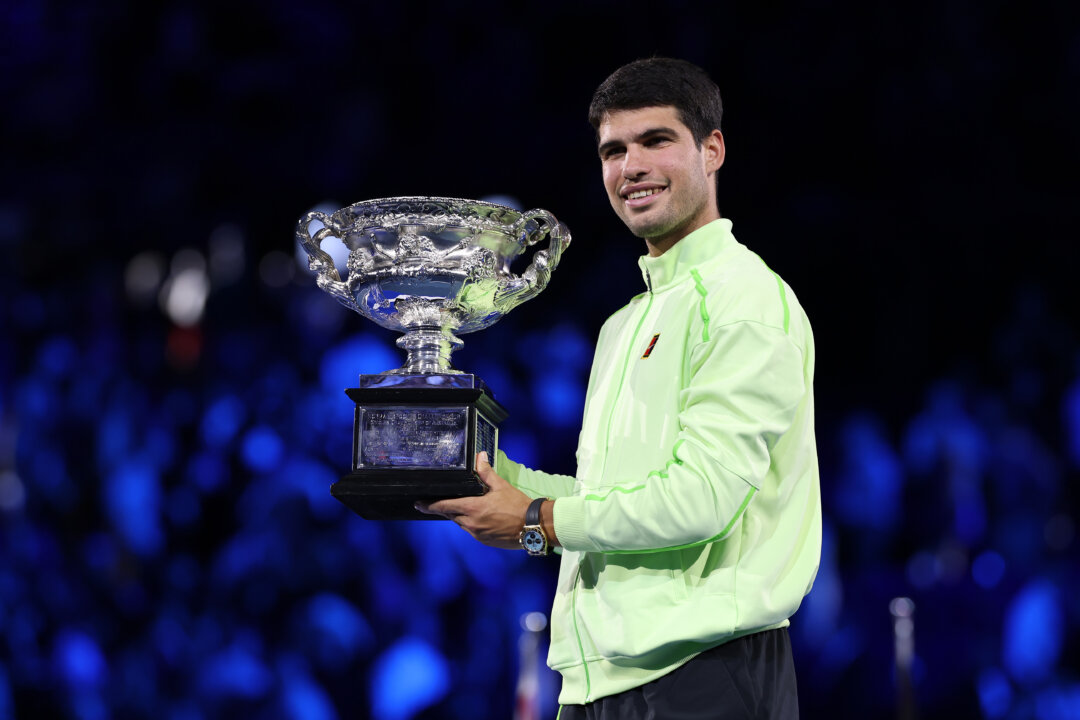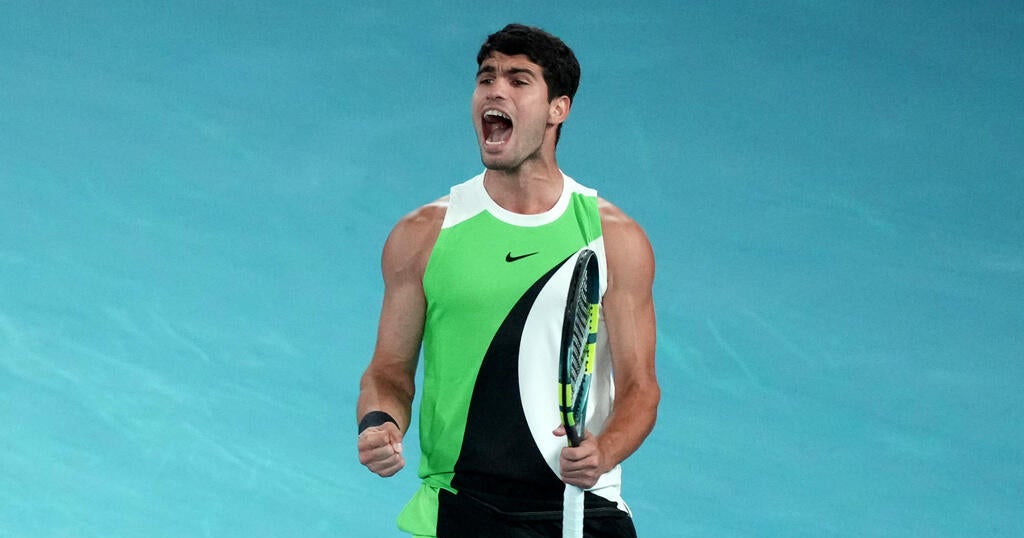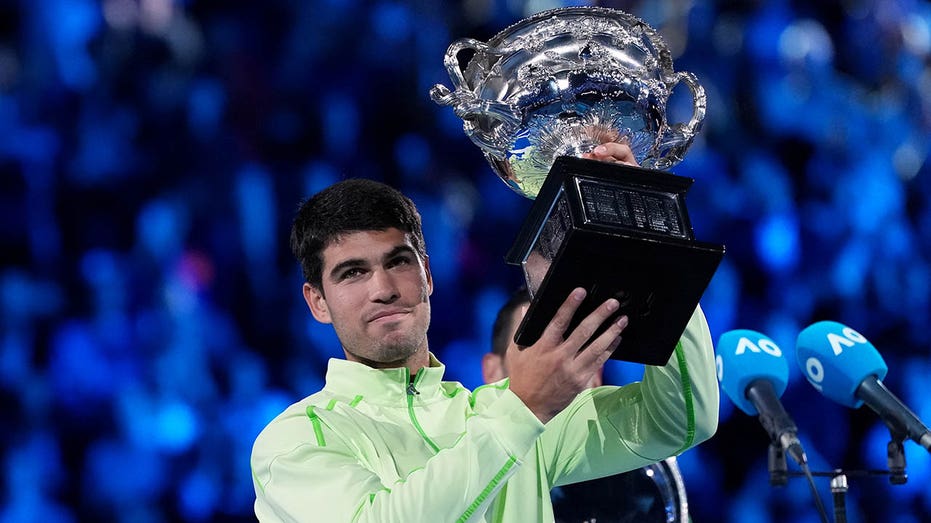





Carlos Alcaraz defeated Novak Djokovic in the 2026 Australian Open final at Rod Laver Arena, winning 2–6, 6–2, 6–3, 7–5 to claim his first Australian Open title and complete the career Grand Slam. Both liberal and conservative outlets agree that this makes Alcaraz, at 22, the youngest man ever to win all four majors, that Djokovic entered the match undefeated in 10 previous Melbourne finals while chasing a record 25th major title, and that Rafael Nadal watched from the stands as part of a highly charged, history‑laden occasion. Coverage converges on the key match dynamics: Alcaraz recovering from a slow start after losing the first set decisively, increasingly outlasting Djokovic in baseline rallies, converting five of 16 break points, and maintaining relentless defensive scrambling and pressure to close out the fourth set.
Across the spectrum, reports frame the result as a historic generational moment in men’s tennis, with Alcaraz’s win symbolizing the rise of a new standard‑bearer as Djokovic nears the twilight of his career. Outlets on both sides highlight Djokovic’s age, physical niggles such as a hip issue, and his gracious post‑match praise of Alcaraz as “already a legend,” while noting the intense atmosphere and crowd swings in Melbourne Park. There is shared emphasis on Alcaraz’s tactical maturity, his adaptation mid‑match, and the validation of his new coaching arrangement with Samuel Lopez after offseason scrutiny, along with the sense that this victory cements his place alongside the Big Three’s legacy in the sport’s historical record.
Areas of disagreement
Framing of generational shift. Liberal-leaning coverage more strongly casts the match as a symbolic passing of the torch, dwelling on Djokovic’s “pull of decline” and the inevitability of younger athletes overtaking aging champions. Conservative outlets acknowledge the generational angle but place slightly more emphasis on continuity of greatness, underscoring Djokovic’s extraordinary 25‑major quest and 10‑0 Melbourne final record to argue that legends remain central to the sport’s narrative. Where liberal sources lean into the idea of a new order in tennis, conservative reporting tends to present Alcaraz’s rise as an addition to, rather than a replacement of, the existing pantheon.
Characterization of Djokovic. Liberal sources describe Djokovic in more elegiac terms, stressing hints of physical vulnerability, the age gap, and crowd dynamics that alternated between support and unease, subtly framing him as a champion battling time as much as his opponent. Conservative outlets portray him more as a still‑formidable force who simply met a better player on the day, highlighting his surges of renewed vigor, late‑match resistance, and the statistical context of his dominance in Australia. The tone on the left tilts toward narrative arc and mortality of greatness, while coverage on the right gives him a more robust, less diminished competitive profile.
Emphasis on Alcaraz’s broader significance. Liberal-leaning reporting devotes more space to Alcaraz’s cultural and historical significance, including Djokovic’s public anointing of him as a “legend” and the symbolic weight of becoming the youngest career Grand Slam champion. Conservative sources focus more heavily on concrete performance metrics—scoreline, break‑point numbers, resilience under pressure—and on how this achievement fits into record‑book milestones rather than broader cultural narratives. As a result, liberal coverage tends to situate Alcaraz’s win in a story about the evolution of the sport and its icons, while conservative coverage frames it as a major but mainly statistical and competitive landmark.
Coaching and preparation. Liberal outlets highlight Alcaraz’s coaching change and offseason criticism, presenting the victory as vindication of his and his team’s strategic decisions and off‑court adjustments. Conservative coverage mentions his team and new coach Samuel Lopez but treats those details as secondary to his on‑court execution, using them mainly to explain his tactical discipline and improved focus in key moments. Thus, liberal reporting uses coaching context to deepen the narrative of growth and risk‑taking, whereas conservative reporting references it chiefly to illuminate how the win was engineered technically.
In summary, liberal coverage tends to treat Alcaraz’s triumph as a richly symbolic turning point that underscores generational change, personal validation, and the fading dominance of Djokovic, while conservative coverage tends to stress the historic but primarily competitive and statistical achievement, defending Djokovic’s stature even in defeat and spotlighting Alcaraz’s performance details over broader narrative framing.