

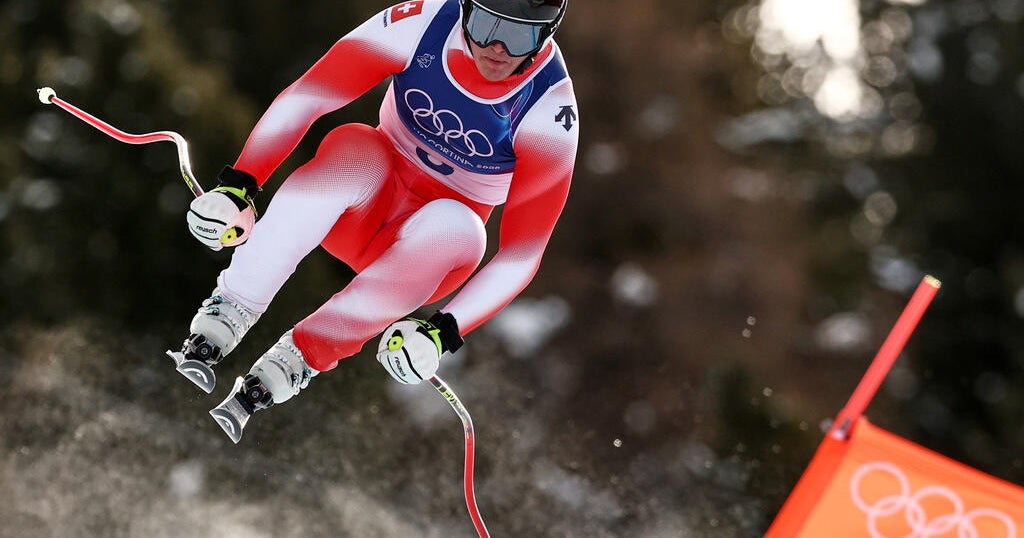
Franjo von Allmen of Switzerland won the men’s downhill, securing the first gold medal awarded at the Milan Cortina 2026 Winter Games, a point on which both liberal and hypothetical conservative coverage would agree. Reports concur that the opening set of medals included von Allmen’s downhill title and Sweden’s Frida Karlsson winning the women’s skiathlon, with American competitors Kyle Negomir finishing 10th in the downhill and Jessie Diggins placing eighth in the skiathlon after recovering from an early fall. Coverage also aligns on von Allmen’s age (24), his clear dominance on a technically challenging downhill course, and the setting of the races as the formal competitive start to the Milan Cortina Olympics.
Liberal and conservative outlets would be expected to agree on von Allmen’s backstory as a key part of the narrative: a relatively unknown skier who relied on crowdfunding, off‑season construction work, and family support to finance his career before breaking through with Olympic gold. Both sides would likely highlight his own characterization of success as stemming from a relaxed mindset and his simple enjoyment of skiing, while noting that Karlsson and Diggins exemplify the depth of Nordic skiing talent worldwide and in the United States. The shared context would stress the importance of the opening downhill as a tone‑setting event for the Games, the demanding nature of the Milan Cortina course, and the broader Olympic theme of athletes overcoming financial and personal obstacles to reach the podium.
Areas of disagreement
Framing of the athlete’s story. Liberal‑aligned coverage emphasizes von Allmen’s crowdfunding and financial precarity as emblematic of systemic underfunding of less‑marketable athletes, while conservative outlets would be more likely to frame the same details as a testament to individual grit, personal responsibility, and entrepreneurial hustle. Where liberal reporting lingers on the precariousness of relying on public donations and side jobs, conservative reporting would tend to celebrate the absence of reliance on large institutions and present his success as proof that hard work pays off without structural overhaul.
Economic and policy implications. Liberal sources are inclined to use von Allmen’s construction work and crowdfunding as a springboard for discussing inequities in sports funding, athlete welfare, and the case for stronger public or federation support. Conservative outlets would more likely downplay calls for expanded subsidies or reforms, instead focusing on private sponsorships, local clubs, and market‑driven solutions as the proper vehicles for supporting talent. The same facts about his financial struggles thus become, on the left, evidence of a funding gap to be fixed, and on the right, an example of how community and individual initiative can already fill that gap.
National and cultural emphasis. Liberal coverage tends to balance the Swiss victory with attention to the international field and narratives of inclusion, highlighting Karlsson’s win and Diggins’s resilience as part of a broader tapestry of global competition. Conservative coverage would be more likely to foreground American results and national pride, stressing what Negomir’s 10th place and Diggins’s comeback say about U.S. competitiveness and character. While both acknowledge von Allmen’s achievement, liberals situate it in a cosmopolitan Olympic context, whereas conservatives are more apt to frame it through national performance and identity.
Meaning of Olympic success. Liberal‑leaning outlets often interpret the story as a testament to social solidarity, collective support networks, and the need to safeguard the Olympic ideal from commercialization and inequality. Conservative‑leaning coverage would more often stress the meritocratic aspect of the Games, portraying von Allmen’s rise from financial hardship as proof that opportunity remains open to anyone willing to work and take risks. The former tends to call for protecting athletes via stronger institutions, while the latter underscores preserving a competitive environment that rewards drive and self‑reliance.
In summary, liberal coverage tends to use von Allmen’s victory as an entry point into discussions about structural inequities, social support, and the collective responsibilities of federations and governments, while conservative coverage tends to highlight personal perseverance, national pride, and the virtues of market‑ and community‑based support in enabling such Olympic success.