

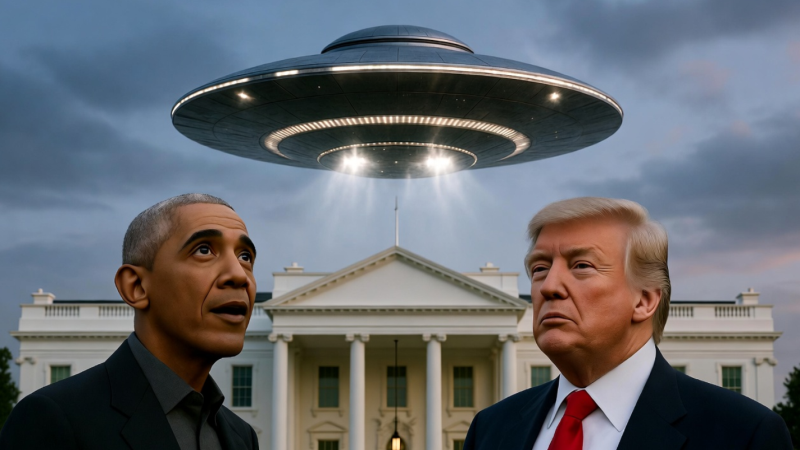
News coverage from both liberal- and conservative-aligned outlets agrees that Donald Trump has publicly called for, or claimed to order, the release or declassification of U.S. government files related to UFOs, also framed as unexplained aerial phenomena, and possible information on extraterrestrial life. Both sides report that he has directed the Pentagon and other federal agencies to identify and prepare relevant documents for public release, characterizing the subject as one of significant or “tremendous” public interest and, in some conservative coverage, as an “extremely important” matter. Coverage further concurs that Trump’s comments have come amid a broader spike in public curiosity about UFOs, and that he has sometimes tied these remarks to prior statements by former President Barack Obama about the likelihood of extraterrestrial life, mentioning declassification in a way that suggests more transparency may be forthcoming.
Liberal and conservative sources also broadly agree on the institutional and historical context in which these directives occur: decades of secrecy and classification around military and intelligence files on UFOs, growing congressional and public pressure for disclosure, and the involvement of agencies such as the Pentagon and the intelligence community. Both perspectives reference a long-running pattern in which presidents, intelligence officials, and the military have periodically addressed or downplayed UFO-related questions, and both treat Trump’s statements as part of a larger trend of incremental disclosure and formal review of unexplained aerial incidents. There is shared acknowledgment that any release process would still move through established classification and national security procedures, and that prior administrations—Democratic and Republican—have overseen various levels of investigation and public communication about UFOs without fully resolving questions about what the government actually knows.
Areas of disagreement
Motives and significance. Liberal-aligned coverage tends to frame Trump’s UFO-file order as a political or media-savvy move to tap into public curiosity, sometimes suggesting it is a distraction from more pressing policy or legal issues and portraying his stance as shallow or inconsistent. Conservative outlets, by contrast, more often cast the order as a meaningful step toward long-delayed transparency, sometimes emphasizing Trump’s willingness to challenge entrenched secrecy and to respond to what he calls “tremendous interest” in the topic.
Credibility and tone. Liberal coverage usually emphasizes Trump’s history of exaggeration and shifting claims, treating his UFO and alien remarks with skepticism and stressing that prior presidents and officials have spoken cautiously about the limits of available evidence. Conservative coverage, especially from populist and conspiratorial outlets, is more likely to take Trump’s statements at face value or amplify them, at times presenting him as uniquely brave in confronting the so‑called deep state and hinting at dramatic revelations to come.
Portrayal of institutions. Liberal-aligned sources tend to treat the Pentagon, intelligence community, and scientific institutions as imperfect but necessary gatekeepers that must balance transparency with national security, often highlighting official cautions that UFOs may be adversary technology or sensor anomalies rather than extraterrestrial craft. Conservative coverage, particularly on the populist right, is more inclined to depict these same institutions as chronically secretive or even hostile to elected oversight, suggesting that entrenched bureaucrats have long suppressed UFO-related truths and are alarmed by Trump’s push for disclosure.
Political framing. Liberal coverage usually situates Trump’s UFO order within a broader critique of his presidency, aligning it with other headline-grabbing announcements and focusing on how he invokes Obama’s comments to score partisan points or mock his predecessor. Conservative coverage more often folds the story into a narrative of Trump battling a corrupt establishment, at times tying UFO disclosure to other scandals or conspiracies—from alleged deep-state plots to high-profile cases like Jeffrey Epstein—to argue that the same hidden networks are resisting transparency across multiple fronts.
In summary, liberal coverage tends to treat Trump’s UFO-file announcement as a largely symbolic, politically motivated gesture warranting skepticism about both his motives and the likelihood of major revelations, while conservative coverage tends to present it as a serious transparency drive that confirms Trump’s role as a disruptor challenging secretive institutions and promising long-suppressed truths.