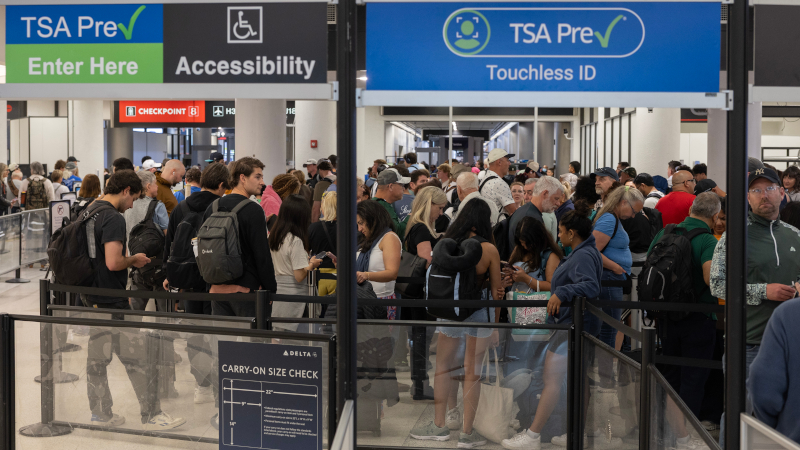


Elon Musk has reportedly offered to personally cover the salaries of Transportation Security Administration agents who have gone unpaid during a partial shutdown of the Department of Homeland Security, which has stretched into its fifth week and 36th day in some accounts. Both liberal- and conservative-leaning sources agree that the lapse in DHS funding has left tens of thousands of TSA officers working without pay, triggered staffing shortages and higher absenteeism, and produced long airport lines and travel disruptions as Senate Democrats push procedural moves to restore TSA funding.
Coverage from both sides also situates the episode within the broader institutional and budgetary standoff over DHS funding and the political struggle in Congress over how to end the shutdown. Outlets across the spectrum describe TSA as an essential security function caught in the crossfire, note the reliance of these federal workers on timely appropriations, and reference parallel fights over related agencies like ICE as part of the same larger funding impasse, while presenting Musk’s offer as an extraordinary private-sector response to a federal pay crisis rather than a normal mechanism for government operations.
Areas of disagreement
Framing of Musk’s role. Liberal-aligned coverage tends to present Musk’s offer in a more skeptical or incidental way, highlighting it alongside the legislative fight and portraying it as a symptom of governmental failure rather than a solution. Conservative outlets emphasize Musk’s move as bold, patriotic, and concrete relief for unpaid workers, framing him as stepping up where political leaders have not and foregrounding his personal initiative.
Political responsibility and blame. Liberal-leaning narratives stress Republican and broader institutional responsibility for allowing DHS funding to lapse, tying TSA’s predicament to partisan brinkmanship and policy disputes over agencies like ICE. Conservative sources, while acknowledging the shutdown’s costs, more often spotlight Senate Democrats’ tactics and missteps, such as Schumer’s verbal slip, suggesting that Democratic obstruction or maneuvering is prolonging the crisis.
Emphasis on policy vs. optics. Liberal coverage places more weight on structural issues such as the vulnerability of essential workers to political standoffs and the need for stable public funding over ad hoc private interventions. Conservative coverage devotes more attention to the optics and symbolism of Musk’s offer, the chaos in airports, and the perceived embarrassment of Democratic leaders, using these elements to argue that decisive action is needed on TSA funding without conceding broader policy ground.
Legitimacy of private intervention. Liberal sources tend to question or downplay the idea that a billionaire’s personal payments are an appropriate stand-in for government payrolls, treating it as an emergency gesture that underscores systemic dysfunction. Conservative outlets are more likely to frame such private intervention as admirable and pragmatically helpful, suggesting that entrepreneurial figures can mitigate harm when government fails or is gridlocked.
In summary, liberal coverage tends to treat Musk’s offer as a revealing but problematic stopgap that underscores governmental and partisan failures around DHS funding, while conservative coverage tends to celebrate Musk’s intervention as evidence of private leadership and use it to criticize Democratic handling of the shutdown and TSA funding fight.
Story coverage