


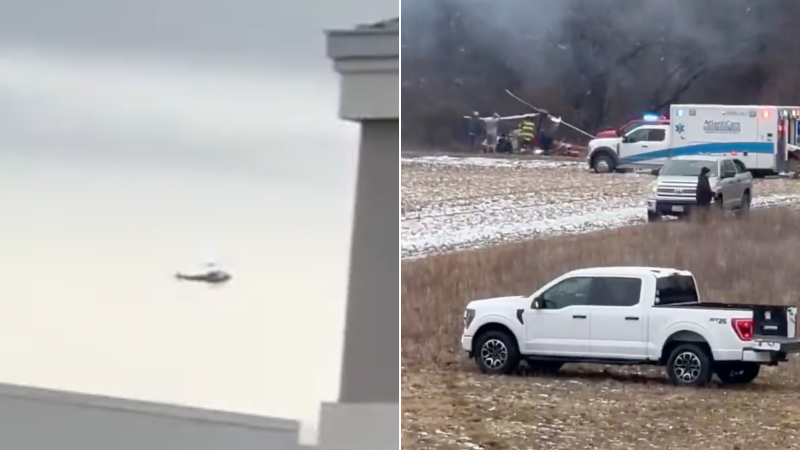
A midair collision between two Enstrom helicopters near Hammonton, New Jersey, on Sunday morning resulted in at least one confirmed death and another person critically or seriously injured, according to both liberal and conservative outlets. The helicopters, each carrying only the pilot, collided near Hammonton Municipal Airport, with one aircraft crashing in or near a field and becoming engulfed in flames and the other coming down in or near a wooded area. Both sides report that local authorities responded quickly to the crash scene and that federal agencies, including the National Transportation Safety Board, have opened an investigation into the cause of the collision. Coverage agrees that official timelines anticipate an initial or preliminary report within days, with a fuller early report expected within roughly 30 days.
Across the spectrum, outlets emphasize that federal safety investigators are in charge of determining what went wrong and that no firm cause has been established. Liberal and conservative sources alike frame the crash within the broader role of the NTSB and federal aviation regulators in overseeing aircraft safety and accident investigations. Both stress the routine investigative process: on‑scene evidence collection, interviews, examination of maintenance records, and eventual publication of findings and any safety recommendations. There is shared acknowledgment that midair collisions of civil helicopters are relatively rare but can prompt reviews of air traffic procedures, pilot training, and operational protocols around smaller municipal airports.
Areas of disagreement
Casualty details and certainty. Liberal-aligned coverage consistently describes one person dead and one person critically injured, stressing that both helicopters had single pilots aboard and that only one fatality is confirmed so far. Conservative outlets mostly echo the one-dead, one-injured framing but also include at least one report asserting that two pilots were killed, introducing confusion about the total death toll. While liberal reporting tends to hedge around evolving numbers and avoid updating casualty counts without clear attribution, conservative coverage is more likely to spotlight the later "two dead" identification piece as definitive, even as some of their own reports maintain the earlier casualty figures.
Emphasis on procedural detail. Liberal sources devote more space to explaining the investigation timeline, explicitly noting expectations for preliminary findings within days and a fuller early report in about 30 days, using the incident to walk readers through how NTSB inquiries typically unfold. Conservative outlets also mention the NTSB probe but focus more succinctly on the fact that a federal investigation is underway, offering fewer specifics about stages or timing. This produces a liberal narrative that foregrounds institutional process and method, while conservative stories concentrate on the immediate facts of the collision and its aftermath with less process-oriented detail.
Framing of local versus national significance. Liberal-aligned coverage tends to situate the crash within broader aviation-safety and regulatory themes, implying potential implications for helicopter operations and oversight at similar small airports around the country. Conservative coverage treats the event more as a discrete local tragedy in southern New Jersey, highlighting location details such as the municipal airport and crash sites without expanding as much into national safety debates or potential reforms. As a result, liberal reporting more often hints at questions about systemic safety practices, whereas conservative pieces largely keep the focus on what happened in this specific incident.
Use of evolving information. Liberal outlets appear more cautious about incorporating incomplete or shifting details, repeating that the cause is unknown and largely avoiding speculation or conflicting casualty counts beyond the initial official statements. Conservative sources, while still noting that the cause is under investigation, are more willing to publish later-sourced specifics like the identification of two deceased pilots even when this temporarily clashes with earlier one-dead accounts. This leads liberal coverage to feel more tightly constrained by confirmed information, while conservative reporting is somewhat more fluid in updating and integrating new but not fully reconciled details into the storyline.
In summary, liberal coverage tends to stress procedural clarity, institutional context, and caution around evolving casualty figures, while conservative coverage tends to foreground the dramatic local tragedy, integrate new identifying details more quickly, and dwell less on broader regulatory or systemic implications.
Story coverage


