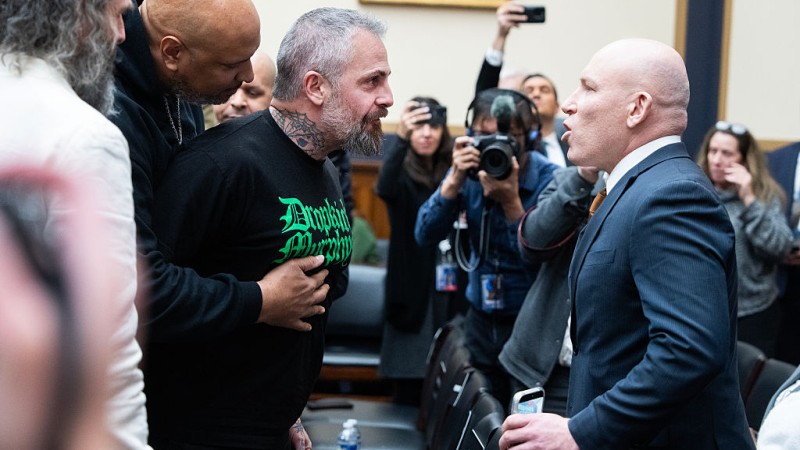

During a House Judiciary Committee hearing related broadly to January 6 and special counsel Jack Smith, former Washington, D.C. Metropolitan Police officer Michael Fanone confronted former Green Beret and conservative activist Ivan Raiklin in the hearing room. Both liberal- and conservative-aligned outlets agree that Fanone shouted profanities at Raiklin, accused him of threatening to rape or harm his children and to kill him, and had to be physically separated or escorted out by Capitol Police or security staff as Democrats on the committee and in the room looked on, with some appearing to cheer or applaud his departure. Coverage from both sides notes that Fanone and Raiklin exchanged words just outside or at the back of the hearing room, that Raiklin framed his initial approach as a benign greeting, and that the confrontation became a disruptive spectacle that briefly overshadowed the scheduled testimony and questioning.
Across the spectrum, reports situate the incident in the broader context of ongoing political and legal battles over the January 6 attack, the prosecution of Donald Trump, and the work of special counsel Jack Smith. Outlets agree that Fanone has become a prominent public figure because of his injuries and testimony related to January 6, while Raiklin is presented as a right-wing operative or activist who has been deeply involved in contesting narratives about the 2020 election and the so‑called "deep state." There is shared recognition that the committee hearing was meant to scrutinize the Justice Department’s conduct—especially regarding January 6 prosecutions and Trump—rather than to host this confrontation, and that the clash reflects the emotionally charged, personalized nature of the broader debate over accountability, political violence, and law enforcement in the post‑January 6 environment.
Areas of disagreement
Characterization of Fanone. Liberal-leaning coverage, where it exists, generally frames Michael Fanone as a visibly traumatized former officer whose outburst, while profane, stems from credible fears about threats against his family in the wake of January 6. Conservative outlets depict him as an "unhinged" or "disgraced" figure and a "J6 TV star" who exploits his status for political theater and lashes out violently at ideological opponents. Liberal narratives emphasize his past heroism and physical injuries, while conservative narratives stress his media profile, partisan alliances, and alleged lack of professionalism during the hearing.
Portrayal of Raiklin. Liberal-aligned sources tend to cast Ivan Raiklin as a "deep state" conspiracy promoter and right‑wing agitator whose presence is part of a broader effort to delegitimize January 6 investigations and the special counsel. Conservative outlets, by contrast, describe him as a former Green Beret, whistleblower, or "deep state marauder" who is calmly asserting his rights and simply greeted Fanone before being verbally attacked. Liberals highlight his role in amplifying election denialism and anti‑institutional narratives, whereas conservatives present him as a patriotic critic of government overreach unfairly targeted by Fanone and Democrats.
Blame and provocation. Liberal coverage typically suggests Fanone’s fury was triggered by prior online and real‑world threats from Raiklin and his circle, framing his accusations about threats to his children as at least plausibly rooted in a pattern of intimidation. Conservative coverage insists Raiklin did nothing more than offer a courteous hello in the hearing room and that Fanone unilaterally escalated into threats and attempted intimidation, even trying to provoke a physical altercation. As a result, liberals stress a context of sustained harassment of January 6 officers, while conservatives focus on Fanone as the sole aggressor and Democrats as complicit in normalizing such behavior.
Meaning of the incident. Liberal-leaning narratives, where they discuss the episode, treat it mainly as a disturbing symptom of how January 6 and related prosecutions have radicalized segments of the right who target law enforcement officers that contradict their preferred storyline. Conservative narratives interpret the clash as emblematic of a weaponized hearing space, where Democrats platform emotionally volatile witnesses like Fanone to smear Trump allies and disrupt scrutiny of Jack Smith and the Justice Department. Liberals therefore view the incident as highlighting ongoing threats to those who defended the Capitol, while conservatives see it as proof of partisan spectacle and the marginalization of dissenting voices.
In summary, liberal coverage tends to view the confrontation as an emotionally charged response by a traumatized officer to perceived ongoing threats from a far‑right operative in the high‑stakes context of January 6 accountability, while conservative coverage tends to portray it as an embarrassing, politically useful meltdown by a media‑savvy former cop against a calm whistleblower at a hearing meant to expose prosecutorial overreach.