

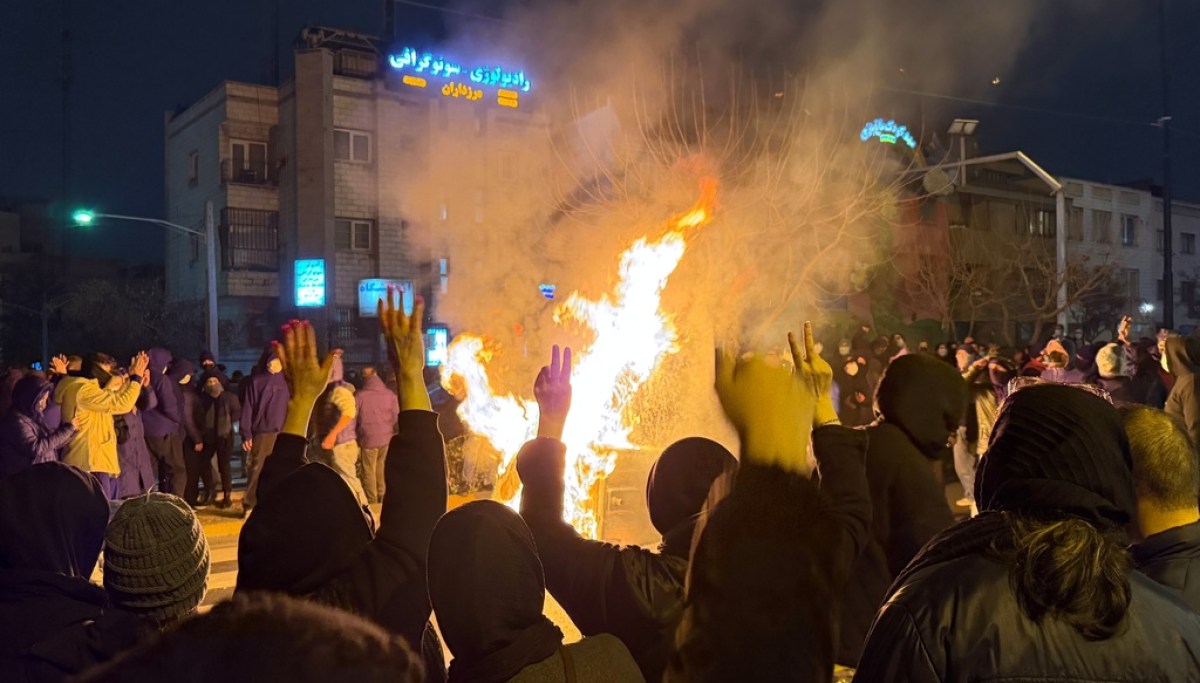
News coverage from both liberal and conservative outlets agrees that Iran’s Prosecutor-General has publicly rejected Donald Trump’s recent claim that he personally halted the execution of around 800 Iranian protesters. Across the spectrum, reports state that Trump, speaking about his foreign policy record, asserted that he threatened Iran and thereby stopped the mass execution of detained demonstrators, but Iranian judicial authorities have called this narrative completely false, insisting no such mass execution order was ever in place. Both sides also highlight that the denial comes as human-rights groups and activists report thousands of deaths from Iran’s broader crackdown on protests, and that the exchange is part of a continuing war of words between Washington figures and the Iranian government.
Liberal and conservative sources likewise provide overlapping context on Iran’s judiciary, describing it as tightly controlled by the Islamic Republic’s power structure while formally asserting its independence from foreign influence. They both situate Trump’s claim and Iran’s denial against the background of long-standing U.S.–Iran hostility, including sanctions, regional military tensions, and Iran’s history of repressing dissent through executions and mass arrests. Coverage on both sides notes that international watchdogs have long accused Iran of being among the world’s top executioners, especially in the wake of major protest waves, and that the contested story about “800 spared executions” taps into wider concerns about human-rights abuses and the credibility of official narratives from both Tehran and former U.S. leaders.
Areas of disagreement
Veracity of Trump’s claim. Liberal-aligned outlets tend to treat Trump’s assertion as almost entirely unsubstantiated, emphasizing the lack of corroborating evidence, Iran’s categorical denial, and Trump’s broader record of exaggeration about foreign-policy wins. Conservative outlets are more likely to repeat Trump’s claim at face value or with only limited skepticism, framing it as at least plausible that strong U.S. pressure could have influenced Tehran’s behavior. While liberals foreground fact-checking and highlight contradictions, conservatives more often stress the possibility that Iran is simply lying to save face or conceal abuses.
Framing of Iran’s denial. Liberal coverage generally presents the Iranian prosecutor’s statement as a predictable but still relevant official rebuttal that undermines Trump’s story, often paired with independent human-rights data rather than deference to Tehran. Conservative coverage, by contrast, frequently characterizes the denial as propaganda from an untrustworthy regime, implying that an authoritarian judiciary has every incentive to obscure both its internal decisions and any foreign impact on them. Thus liberals use the denial to question Trump’s narrative, while conservatives use Iran’s lack of credibility to keep Trump’s version in play.
Portrayal of U.S. influence and strength. Liberal outlets tend to downplay the idea that a single Trump threat could have directly halted a mass execution order, instead situating any changes in Iranian behavior within broader diplomatic, economic, and domestic-pressure dynamics. Conservative outlets are more inclined to cast Trump’s claimed intervention as an example of effective deterrence, fitting it into a wider story that his hardline stance made adversaries think twice. This leads liberals to stress structural causes and multilateral pressures, while conservatives emphasize personal leadership and the impact of forceful rhetoric.
Focus on human-rights accountability. Liberal coverage often uses the episode to refocus attention on Iran’s ongoing human-rights violations, arguing that unverifiable rescue narratives risk obscuring the need for sustained international accountability and documentation. Conservative coverage also notes Iran’s abuses but is likelier to fold them into a narrative that contrasts Trump’s toughness with what they portray as weaker responses from other U.S. administrations. As a result, liberals frame the story as a cautionary tale about political self-aggrandizement overshadowing victims, whereas conservatives lean toward using it to underscore the stakes of having a forceful U.S. posture toward Iran.
In summary, liberal coverage tends to treat Trump’s claim as a dubious, largely unverified boast that distracts from systematic human-rights abuses and the need for evidence-based scrutiny, while conservative coverage tends to keep Trump’s version of events plausible, casting Iran’s denial as regime spin and highlighting the potential power of strong U.S. leadership to deter hostile actions.
