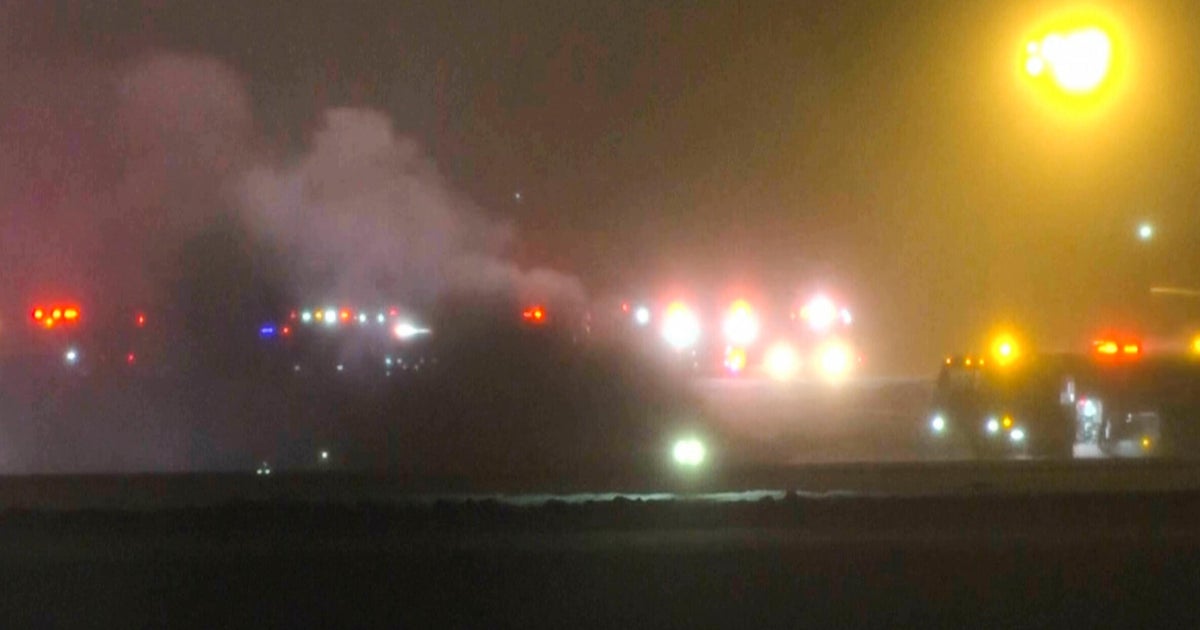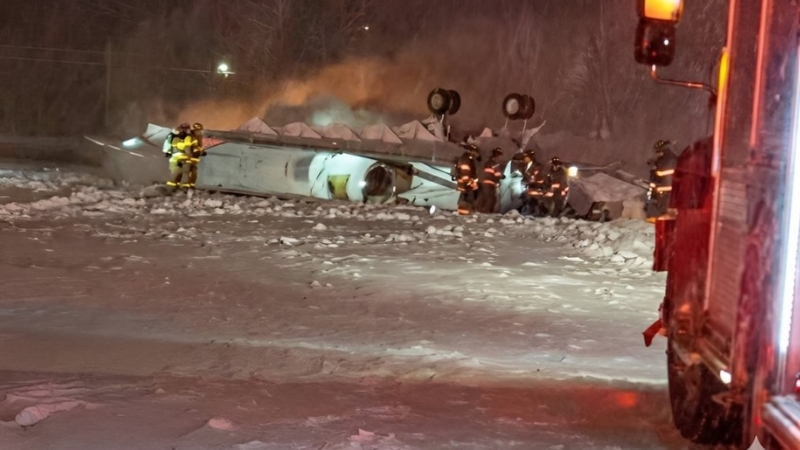




A Bombardier Challenger 600 private jet carrying eight people crashed during takeoff Sunday night at Bangor International Airport in Maine amid a snowstorm that was reducing visibility. The plane flipped, caught fire, and resulted in multiple fatalities; most reports now converge on six dead, with early accounts ranging from all eight presumed dead to seven killed and one seriously injured. Both liberal- and conservative-aligned outlets agree that the aircraft attempted to depart in poor weather, that the airport was subsequently closed with numerous flight cancellations and diversions, and that the Federal Aviation Administration and the National Transportation Safety Board have opened investigations into the cause of the crash.
Coverage across the spectrum similarly notes that the jet was a Bombardier Challenger 600 registered to an LLC based in Houston, Texas, and linked to the prominent trial law firm Arnold & Itkin. Reports agree that, at the time of publication, it remained unconfirmed whether any of the firm's named partners were on board, and that the identities of the victims had not been officially released. Both sides describe the crash within the broader context of a large winter storm disrupting air travel across the eastern United States and emphasize that federal investigators will examine factors such as weather, aircraft performance, and operational decisions, with any policy or safety reforms dependent on the outcome of those inquiries.
Areas of disagreement
Victim identity and political profile. Liberal-aligned outlets mention the registration link to Arnold & Itkin and their political activity but keep the focus primarily on the crash mechanics, casualties, and investigation, often treating the law firm’s political stance as secondary background. Conservative outlets, by contrast, foreground the firm’s identity as anti-ICE, pro-immigration, and heavily supportive of Democrats, emphasizing their work for immigrants and opposition to conservative policies. Where liberal coverage tends to avoid speculating about which specific attorneys were on board, conservative pieces more aggressively tie the incident to the two named partners and their political and legal activism, even as they acknowledge that their presence on the flight is unconfirmed.
Tone and framing of the tragedy. Liberal sources frame the story chiefly as an aviation disaster within a severe winter-weather pattern, emphasizing safety, infrastructure disruption, and procedural investigation. Conservative sources often adopt a more sensational tone, using language like “top anti-ICE lawyers” and placing the crash within a culture-war frame that highlights the victims’ political and legal roles. This leads liberal pieces to read more like standard transportation-news coverage, while conservative pieces mix breaking-news style with ideological commentary about the passengers’ work and values.
Emphasis on cause and responsibility. Liberal-aligned reporting focuses on the snowstorm, low visibility, and standard investigative process, stressing that it is too early to draw conclusions about pilot error, mechanical failure, or regulatory shortcomings. Conservative coverage mentions the storm as well but spends less space on technical causation, instead centering on who owned the plane and what they stood for politically. As a result, liberal outlets lean into institutional accountability via FAA and NTSB procedures, while conservative outlets lean into narrative accountability tied to the owners’ identities, leaving the mechanical and regulatory questions relatively underdeveloped.
Political implications and subtext. Liberal coverage largely avoids extrapolating political implications from the victims’ affiliations, treating their donations and advocacy as factual context rather than a lens for interpreting the crash. Conservative outlets, however, implicitly invite readers to view the event through partisan and immigration-policy frames, repeatedly labeling the lawyers as representing illegal immigrants and opposing conservatives. This divergence means liberal stories strive to bracket politics off from the tragedy, while conservative stories position politics near the center of the narrative even in the absence of clear links between the crash and any policy dispute.
In summary, liberal coverage tends to treat the crash primarily as an aviation disaster shaped by severe weather and subject to standard federal investigation, while conservative coverage tends to foreground the political and immigration-related identities of the jet’s owners and passengers, framing the event within broader ideological narratives.