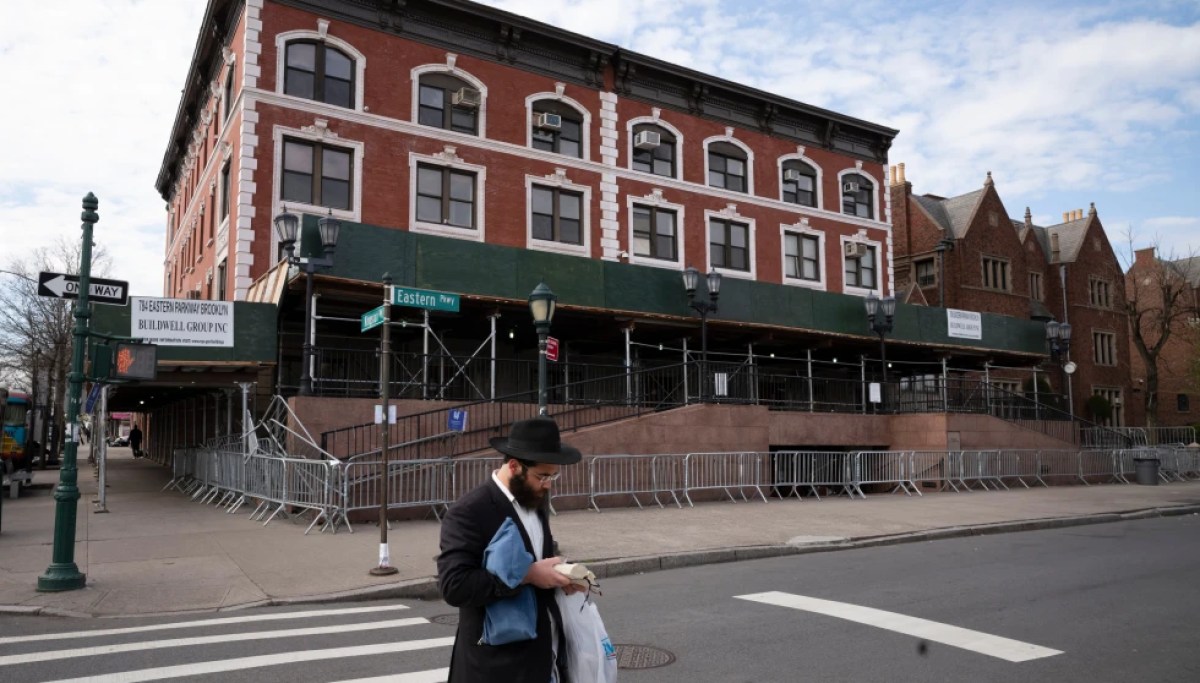


A 36-year-old man from New Jersey was arrested after repeatedly ramming his car into the front entrance of the Chabad Lubavitch World Headquarters in the Crown Heights neighborhood of Brooklyn, New York. Both liberal and conservative outlets agree that the incident occurred at night while large numbers of people were inside the building for religious observances, that the driver struck the building multiple times in what appeared to be an intentional act, and that police quickly responded and took him into custody. They also concur that the New York Police Department is investigating the incident as a possible hate crime targeting a prominent Hasidic Jewish institution, and that the building is a central site for Chabad-Lubavitch activities and worship.
Across the spectrum, coverage notes that no explosives were found after the bomb squad examined the vehicle and that law enforcement has increased security and police presence at Jewish houses of worship and other religious sites citywide in response. Both liberal and conservative sources characterize Chabad Lubavitch World Headquarters as a major global center of Hasidic Jewish life and describe the timing as coinciding with significant religious gatherings and prayer. Outlets from both sides emphasize that the investigation is ongoing, that authorities have not yet publicly announced a definitive motive, and that community members and leaders are treating the event with seriousness in light of broader concerns about antisemitic threats.
Areas of disagreement
Motive and hate-crime framing. Liberal-aligned coverage emphasizes the hate-crime investigation label early and prominently, presenting the incident primarily through the lens of rising antisemitism and threats to Jewish communities. Conservative outlets also mention that it is being investigated as a possible hate crime but more quickly note the absence of a confirmed motive and avoid presuming ideological intent. Some conservative reporting further complicates a straightforward hate-crime narrative by highlighting that the suspect had recently danced and socialized with congregants at the same Chabad site, suggesting ambiguity about his intentions in a way liberal pieces largely do not explore.
Context and broader narratives. Liberal coverage situates the ramming within a wider pattern of antisemitic incidents and security concerns at Jewish institutions, focusing closely on the vulnerability of worshippers and the symbolic targeting of a major religious center. Conservative sources, while acknowledging antisemitic risks, tend to fold the incident into a broader thematic package that includes political debates about antisemitism, controversies over public figures’ Holocaust analogies, and scrutiny of international agencies accused of antisemitic indoctrination. This framing presents the attack as one data point in a larger struggle against antisemitism across political, diplomatic, and institutional arenas, rather than as an isolated domestic crime.
Law enforcement and public-order angle. Liberal outlets highlight the rapid police response and enhanced protection for Jewish sites mainly as a necessary safeguard for a community under threat, with less emphasis on policing policy debates beyond that. Conservative reporting, while similarly noting increased security and the bomb squad’s involvement, tends to stress the incident as evidence of ongoing security challenges and the need for robust law enforcement measures to protect religious communities. In some conservative pieces, the language underscores decisive police action and heightened vigilance as part of a broader law-and-order posture that resonates with their audience.
Political implications and rhetoric. Liberal-aligned coverage in this case is more narrowly focused on the specific act and community impact, generally avoiding partisan political blame or extended discussion of national political figures in connection with the incident. Conservative sources more readily juxtapose the Chabad ramming with criticisms of Democratic officials’ rhetoric about immigration and the Holocaust, implying that careless analogies and politicized discourse dilute the seriousness of antisemitism. This creates an implicit contrast between what conservatives portray as real, violent antisemitic threats, such as the Chabad incident, and what they see as irresponsible political messaging on the left.
In summary, liberal coverage tends to foreground the event as a clear manifestation of growing antisemitic danger and a security crisis for Jewish institutions, while conservative coverage tends to place the incident within a broader law-and-order and political narrative that stresses ambiguity about motive, the need for strong enforcement, and critiques of how antisemitism is discussed in wider public debate.