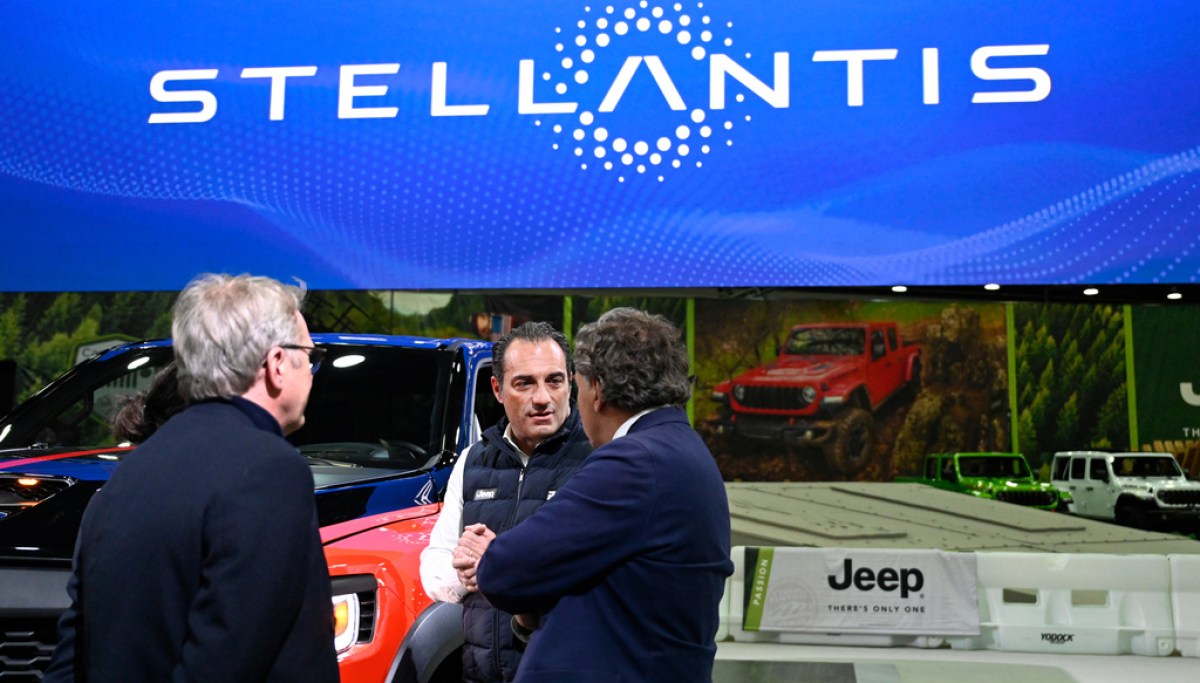
Stellantis has announced a massive write-down of roughly €22bn (about $23–26bn, with some conservative outlets citing a higher total hit of up to $35bn when related items are included), tied largely to a reassessment of its electric-vehicle strategy and associated assets. Both liberal and conservative outlets report that the company admitted it had “overestimated” the pace of the shift to fully electric vehicles, is taking a substantial non-cash impairment on EV-related investments, and is retreating from earlier aggressive battery-electric targets. Coverage agrees that Stellantis shares plunged sharply on the news, that the group will suspend its dividend for 2026, and that it plans to sell its 49 percent stake in the NextStar Energy battery plant in Windsor, Ontario, to its partner LG Energy Solution for a nominal price of about $100 while remaining a customer of the facility. All sides also concur that Stellantis will continue to develop EVs but will rebalance its lineup toward hybrids and internal-combustion-engine vehicles, pacing new EV investment more closely with actual demand and evolving regulations.
Liberal and conservative sources broadly agree that Stellantis’s move reflects softer-than-expected consumer demand for EVs, especially in North America, as well as shifting regulatory signals around emissions and electrification targets. They both describe the company’s own statements about “poor operational execution” and misaligned product planning as key contributors, alongside high EV costs, range concerns, and infrastructure limitations that have slowed adoption. Outlets on both sides highlight the role of joint ventures and large-scale battery plants in automakers’ electrification strategies, noting that Stellantis is not abandoning EVs but recalibrating timelines, technology choices, and capital commitments. There is also common acknowledgment that this retrenchment underscores industry-wide uncertainty about how quickly consumers will move from internal-combustion and hybrids to full battery-electric vehicles, and that investors are reassessing the risks and profitability of aggressive EV build-outs.
Areas of disagreement
Interpretation of the EV slowdown. Liberal-aligned coverage typically frames Stellantis’s charge as an adjustment to overly optimistic forecasts and execution missteps within a still-inevitable long-term transition to cleaner vehicles, stressing that demand is delayed rather than disappearing. Conservative coverage more often portrays the move as evidence that consumer appetite for EVs is fundamentally weaker than political and corporate elites claimed, suggesting that the market is pushing back against an imposed transition. Liberal outlets tend to emphasize cyclical and technological factors like charging build-out and cost curves, while conservative outlets highlight structural consumer skepticism and preference for conventional or hybrid cars.
Role of regulation and policy. Liberal sources generally describe regulations as evolving guardrails that Stellantis misread, arguing that shifting US rules and mixed policy signals complicated planning but remain directionally supportive of decarbonization. Conservative coverage more frequently casts climate and emissions mandates as heavy-handed policies that distorted investment decisions and pressured companies into overcommitting to EVs before demand was proven. Where liberal outlets focus on the need for clearer, more consistent standards to guide industry, conservative outlets stress that loosening or delaying mandates vindicates a slower, market-driven approach that automakers like Stellantis are now embracing.
Assignment of responsibility. Liberal reporting tends to stress the company’s own strategic and operational errors, such as misjudging consumer preferences, product mix, and timing, presenting the write-down as a corporate execution failure within a challenging but navigable transition. Conservative outlets more readily broaden the blame to include governments and environmental advocates, arguing that political pressure and subsidies encouraged Stellantis and others to gamble on EVs in ways that were detached from real-world demand. While liberals frame the event as a cautionary tale about corporate forecasting and implementation, conservatives frame it as a warning about policy-driven industrial planning.
Implications for the EV transition. Liberal-aligned media often characterizes Stellantis’s retrenchment as a temporary recalibration that may slow near-term rollouts but does not alter the long-run trajectory toward electrification, pointing to the company’s ongoing EV plans and continued battery procurement. Conservative coverage is more likely to present it as a bellwether that the rapid, mandated EV transition is unraveling, suggesting other automakers will also scale back and that hybrids and combustion engines will remain central for longer. Liberals generally talk in terms of course correction and diversification of powertrains, whereas conservatives emphasize retreat, skepticism, and the potential reversal of broader EV ambitions.
In summary, liberal coverage tends to treat Stellantis’s massive charge as a significant but ultimately corrective step within a still-ongoing shift to cleaner vehicles driven by policy and technology, while conservative coverage tends to see it as validation that politically driven EV targets overshot consumer reality and that markets are forcing a slower, more combustion- and hybrid-heavy path.