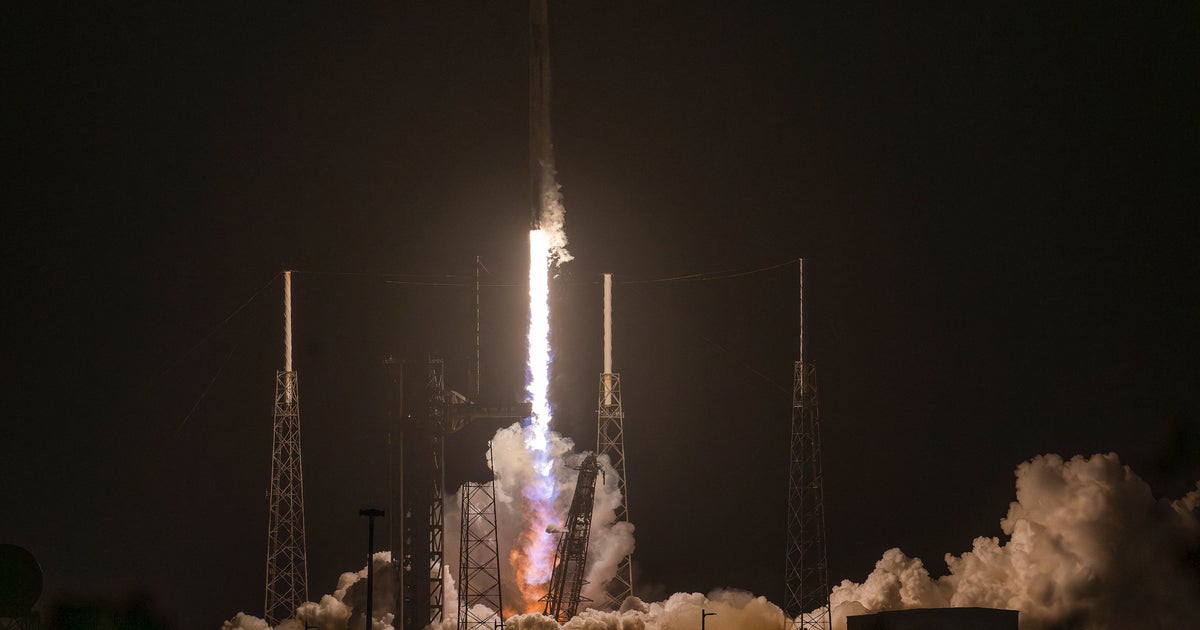


SpaceX’s Falcon 9 rocket successfully launched the Crew-12 mission from Florida to the International Space Station, carrying four crew members: two U.S. astronauts, one French astronaut, and one Russian cosmonaut. Both liberal- and conservative-leaning outlets agree this is the 12th long‑duration ISS team flown by NASA on a SpaceX vehicle, that the crew will dock with and join three existing occupants on the station, and that the mission is planned to last roughly eight months. Coverage across the spectrum also presents the flight as another successful operational crew rotation to the ISS under NASA’s commercial crew program.
Across outlets, the mission is framed as part of an ongoing, institutionalized partnership between NASA and SpaceX to maintain continuous human presence on the ISS and to support scientific research in microgravity. Liberal and conservative reports both note that the crew will conduct a range of experiments, including biological studies on bacteria and plant interactions and technology demonstrations aimed at supporting future lunar and Martian exploration. The launch is also placed within the broader context of routine ISS crew rotation, with Crew-12 relieving a previous crew that has returned to Earth, underscoring the normalization of commercial spacecraft as a primary means of U.S. access to low Earth orbit.
Areas of disagreement
Mission emphasis and framing. Liberal-aligned outlets emphasize the scientific goals of Crew-12, detailing experiments on microbes, plants, and technologies intended to enable future Moon and Mars missions, and present the launch as a milestone in long-term exploration and research. Conservative-leaning coverage, by contrast, foregrounds the operational aspect of replacing a recently evacuated crew and highlights the novelty of NASA’s first medical evacuation. While liberal reports frame the mission chiefly as a planned research expedition, conservative pieces frame it more as a response to an unusual crew-rotation contingency, giving the story a more incident-driven narrative.
Tone about normalization vs. risk. Liberal coverage tends to portray Crew-12 as part of a now-routine cadence of safe, reliable SpaceX flights under NASA’s commercial crew program, stressing continuity in long-duration missions and incremental progress in science. Conservative outlets, while acknowledging success, implicitly dwell more on the underlying risks by centering the prior medical evacuation and the need to replace that crew, making the mission feel less routine and more like a reminder that human spaceflight remains hazardous. The result is that liberal stories normalize crewed launches as a stable platform for research, whereas conservative pieces subtly underscore the fragility and complexity of maintaining a human presence in orbit.
Institutional and partnership focus. Liberal sources devote more attention to the NASA–SpaceX partnership, multinational cooperation among U.S., French, and Russian crew members, and how commercial providers are enabling sustained ISS operations and future exploration architectures. Conservative coverage, in the limited details provided, is more narrowly focused on NASA’s management of crew safety and its handling of the medical evacuation, with less emphasis on international or commercial collaboration. This leads liberal outlets to situate Crew-12 within a broader narrative of public–private and international cooperation, while conservative ones lean toward a more national program and incident-specific framing.
In summary, liberal coverage tends to highlight the mission’s scientific agenda, the normalization of commercial crew flights, and the broader cooperative architecture of human spaceflight, while conservative coverage tends to spotlight the extraordinary context of the prior medical evacuation, the risks and contingencies of crew rotation, and NASA’s handling of safety and replacement logistics.
Story coverage