

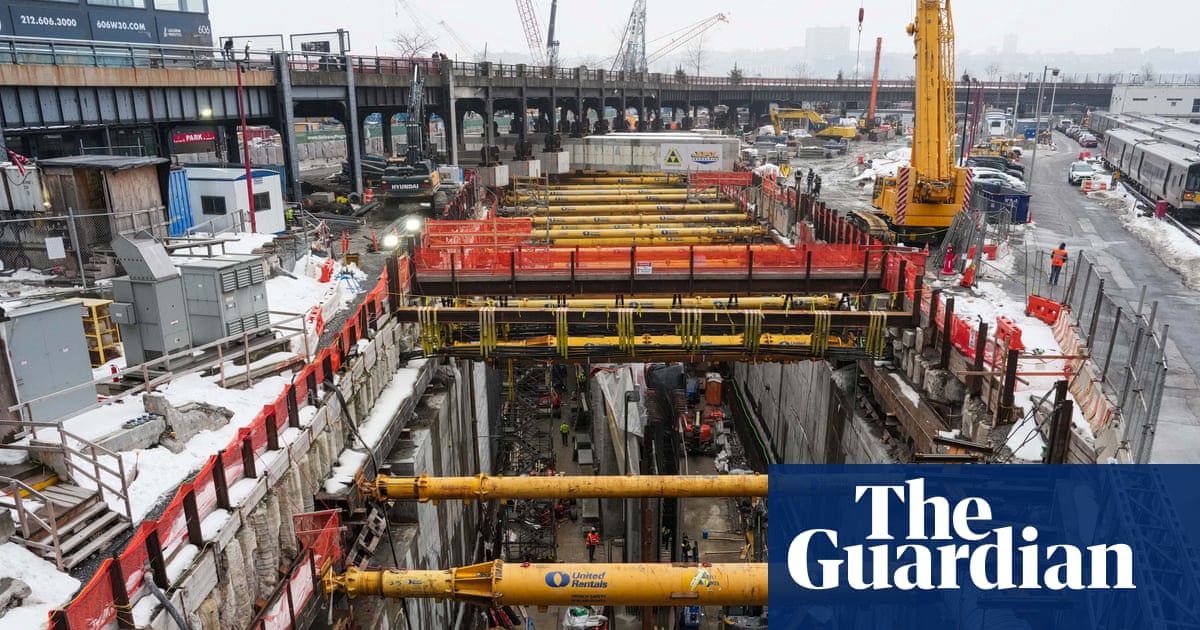
The Trump administration has released approximately $127 million in overdue federal funds for the New York–New Jersey Gateway rail tunnel project, made up of roughly $98 million in withheld payments plus about $30 million in reimbursements. Coverage across the spectrum agrees that the funds’ release comes after a federal judge blocked the administration’s attempt to withhold the money, that construction work which had slowed or stopped is now expected to resume next week, and that state officials and contractors view this as a green light to move forward with the project and keep hundreds of jobs on track.
Liberal and conservative-aligned descriptions concur that the Gateway project is a major infrastructure effort designed to increase rail capacity under the Hudson River between New York City and New Jersey and to repair an aging tunnel damaged during Hurricane Sandy. Both sides note that the dispute centered on federal funding obligations and timing rather than the project’s basic design, and that the decision affects broader regional transportation reliability and economic activity. There is also agreement that continued long-term funding certainty is critical to completing the tunnel and associated upgrades, given the project’s multi-year scope and cost.
Areas of disagreement
Motives and obstruction. Liberal-aligned sources portray the earlier withholding of funds as politically motivated obstruction by the Trump administration, emphasizing the president’s past description of Gateway as a “future boondoggle” and reports of personal demands over naming rights for airports or stations. In contrast, conservative narratives are more likely to frame the delay as part of a broader skepticism about large, high-cost infrastructure commitments and a desire to protect federal taxpayers. While liberals stress the judge’s ruling as proof that the administration overstepped legal and budgetary norms, conservatives characterize the episode as a hard-nosed negotiation over spending priorities rather than an abuse of power.
Fiscal risk and project framing. Liberal coverage tends to highlight the Gateway tunnel as an essential, long-overdue investment in critical infrastructure whose cost is justified by the economic importance of the Northeast Corridor. Conservative coverage, when discussing similar projects, generally stresses the risk of cost overruns, long-term subsidies, and the potential for waste, often echoing “boondoggle” concerns and questioning whether states should shoulder more of the burden. As liberals underscore the regional and even national economic stakes of a tunnel failure, conservatives focus on whether federal funds are being used efficiently and whether local beneficiaries are paying their fair share.
Role of courts and institutions. Liberal sources emphasize the federal judge’s order as a necessary check on executive overreach and as a vindication of legal mechanisms protecting apolitical infrastructure funding commitments. Conservative perspectives are likelier to treat the judicial intervention as part of an ongoing tug-of-war between elected branches and the courts, sometimes implying that judicial second-guessing can constrain legitimate executive discretion over how and when money is disbursed. Where liberals present the court as safeguarding institutional norms and contracts, conservatives worry more about courts locking in spending trajectories that reduce flexibility for future administrations.
Political credit and accountability. Liberal coverage gives little substantive credit to the Trump administration for ultimately releasing the funds, treating the move as a forced concession after legal defeat and public pressure. Conservative coverage, by contrast, tends to emphasize that, regardless of prior disputes, the administration did authorize the release and may present this as evidence it is not reflexively anti-infrastructure. Liberals focus on holding the administration responsible for months of uncertainty and near job losses, whereas conservatives are more inclined to spread accountability across state leaders, Congress, and prior administrations that shaped the project’s financing.
In summary, liberal coverage tends to frame the funds’ release as a reluctant climbdown by an administration that tried and failed to politicize a vital infrastructure project, while conservative coverage tends to downplay accusations of political punishment and instead stress budgetary caution, negotiation over costs, and the ultimate follow-through on federal funding commitments.
