
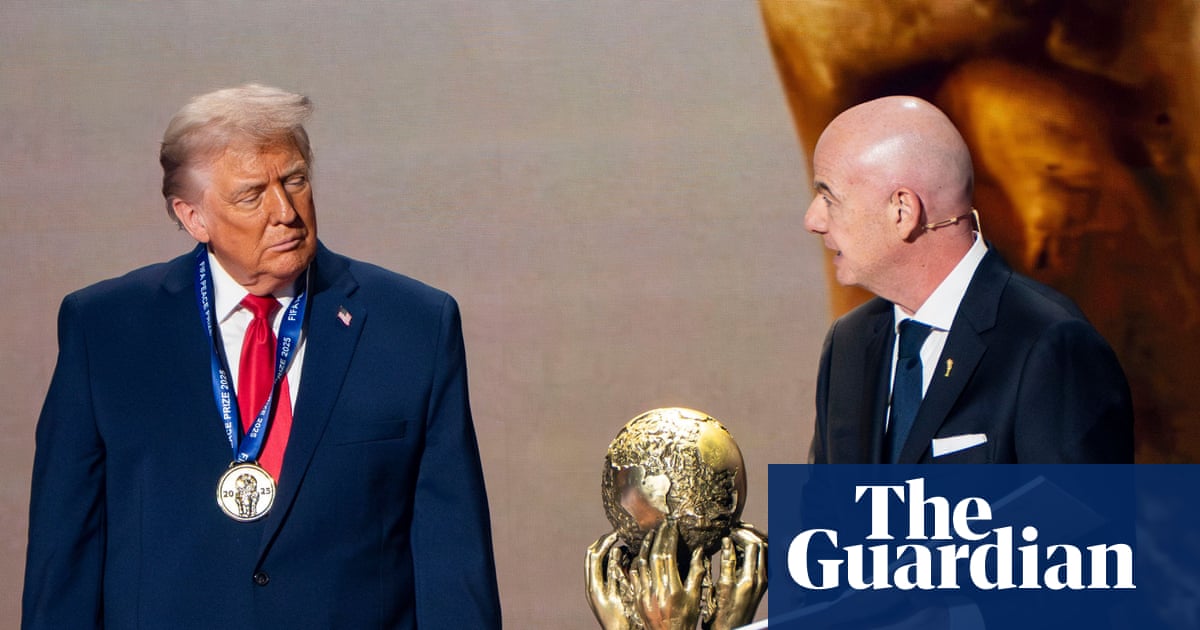
Donald Trump has publicly questioned whether Iran’s national soccer team should participate in the upcoming North American World Cup, saying it may not be "appropriate" for them to attend and repeatedly citing concerns about the players’ "life and safety." Both liberal- and conservative-leaning outlets agree that these comments mark a shift from Trump’s earlier assurances to FIFA president Gianni Infantino that Iran would be allowed and even "welcome" to compete, despite strained U.S.-Iran relations. Reporting across the spectrum notes that Iran’s sports minister had already said the team could not participate under any circumstances, a stance linked to broader political tensions and U.S. actions that have affected bilateral relations.
Coverage from both sides situates Trump’s remarks against the backdrop of high-stakes international politics, including a deteriorated U.S.-Iran relationship and references to war or war-like conditions between the two countries. They generally concur that FIFA, as global football’s governing body, is being placed in a difficult position by conflicting political signals: a host-country leader raising security and appropriateness concerns while FIFA seeks a politically neutral and inclusive tournament. Outlets on both sides also acknowledge that Trump’s comments highlight the intersection of sports diplomacy, national security considerations, and domestic political messaging, raising questions about how geopolitical conflicts influence participation in major international sporting events.
Areas of disagreement
Framing of Trump’s intent. Liberal-aligned coverage tends to portray Trump’s comments as contradictory and politically opportunistic, suggesting his invocation of safety is a pretext that further politicizes the World Cup and undermines prior assurances to FIFA. Conservative outlets are more inclined to frame his statements as a sober reassessment based on changing conditions, emphasizing his stated concern for the Iranian players’ safety in a hostile geopolitical climate. While liberals stress inconsistency and potentially inflammatory rhetoric, conservatives highlight prudence and national-security sensitivity.
Characterization of the safety threat. Liberal sources often question the specificity and credibility of the claimed safety risk, underscoring that Trump did not present concrete evidence and implying that the "life and safety" language amplifies tensions rather than addressing a clearly defined threat. Conservative sources, by contrast, take the existence of a serious risk more at face value, tying it to ongoing war-like conditions and broad instability surrounding U.S.-Iran relations. The liberal narrative tends to view the danger as rhetorically inflated, while conservative reporting normalizes Trump’s warning as a reasonable response to a volatile environment.
Responsibility and politicization. Liberal-leaning coverage is more likely to argue that Trump himself is contributing to the politicization of the tournament, blaming his combative posture toward Iran and shifting signals for making participation more difficult and less safe. Conservative coverage more often attributes responsibility to Iran’s leadership and to the broader conflict, framing the sports minister’s declaration that Iran "cannot participate" as a reaction to U.S. policies but ultimately grounded in Tehran’s choices and hostile stance. Thus, liberals emphasize how U.S. presidential rhetoric constrains FIFA and players, while conservatives emphasize Iranian intransigence and the preexisting conflict as the root problem.
Impact on international norms. Liberal outlets tend to stress that linking World Cup access to bilateral political disputes undermines the tradition of sports as a neutral ground, framing Trump’s statement as another erosion of multilateral norms and FIFA’s independence. Conservative outlets are more inclined to argue that security and appropriateness must override abstract notions of neutrality, presenting Trump’s skepticism about Iran’s attendance as compatible with responsible hosting obligations. Where liberals see a dangerous precedent of politicized exclusion, conservatives are more apt to see a pragmatic recalibration of sports diplomacy amid conflict.
In summary, liberal coverage tends to cast Trump’s safety-based objections as politically driven, inconsistent, and corrosive to the idea of sports as a neutral arena, while conservative coverage tends to present his comments as a rational, security-focused response to heightened U.S.-Iran tensions and the risks of bringing a rival nation’s team to a conflict-tinged World Cup.
Story coverage