

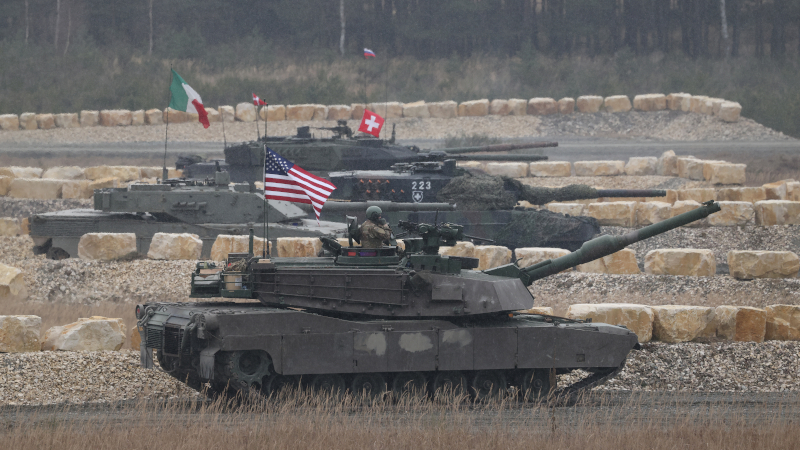
Switzerland has announced a pause on military and defense-related exports to the United States, framed in both liberal and conservative coverage as a consequence of its longstanding neutrality amid escalating hostilities between the US and Iran. Reports agree that the measure applies to official arms and dual-use military items, that the financial volume of recent Swiss defense exports to the US has been relatively modest, and that the timing coincides with heightened tensions in the broader Middle East, particularly around the Strait of Hormuz. Both sides describe the step as officially justified under Swiss neutrality law and export-control rules, emphasize that it is described by Bern as temporary or conditional on the evolution of the conflict, and note that Switzerland is trying to avoid being seen as supporting one belligerent in a potential Iran war.
Liberal and conservative sources similarly situate the move within Switzerland’s historic role as a neutral state and diplomatic intermediary, stressing that its export-control regime is designed to prevent Swiss-made weapons or components from being used in active conflicts. They concur that the decision reflects institutional constraints rooted in Swiss law and public opinion, which have previously led to restrictions on arms exports to other war zones, and that this is consistent rather than an unprecedented break with past practice. Both sides also reference the broader Western debate over arms transfers and neutrality norms, acknowledging that Switzerland seeks to maintain credibility as a mediator in Middle East disputes and to uphold its reputation in multilateral forums where neutrality and humanitarian law are central.
Areas of disagreement
Motives and symbolism. Liberal-aligned outlets tend to portray the halt as a principled, rules-based application of neutrality, emphasizing legal obligations and Switzerland’s desire to avoid complicity in any Iran-related hostilities. Conservative outlets, by contrast, frame it more as a pointed diplomatic signal or symbolic snub toward Washington at a sensitive geopolitical moment, suggesting that Bern is choosing optics over alliance solidarity. Where liberal coverage stresses continuity with Switzerland’s past neutrality behavior, conservative coverage highlights the timing and framing as politically charged and unnecessarily provocative.
Impact and stakes. Liberal coverage generally underscores that the economic and military impact on the US is limited due to the small volume of Swiss arms exports, depicting the move as largely about ethics and legal coherence rather than material consequences. Conservative sources more often dwell on strategic and political repercussions, arguing that even a small embargo can erode trust, complicate transatlantic defense cooperation, and feed US frustration with European partners over burdens in the Strait of Hormuz and broader Middle East security. This leads liberal reports to downplay practical fallout, while conservative ones elevate it as part of a worrying pattern.
Framing of US role and Iran conflict. Liberal outlets are more inclined to situate the decision within concerns about US military posture toward Iran and the risks of escalation, implicitly questioning the wisdom or legality of potential US actions that could trigger neutrality constraints. Conservative coverage tends to foreground Iran’s destabilizing activities and aggression, presenting the conflict context as one where Western unity is needed and Switzerland’s stance may inadvertently benefit Tehran diplomatically. As a result, liberal narratives cast the halt as a safeguard against entanglement in a contentious war, whereas conservative narratives see it as an unhelpful constraint on the US in confronting Iran.
Alignment and broader Western cohesion. Liberal reporting often highlights Switzerland’s non-NATO status and independent foreign-policy tradition, casting the move as a sovereign choice consistent with its distinct role within Europe. Conservative outlets are more likely to interpret it against the backdrop of recurring European hesitancy on hard power and defense cooperation, viewing the halt as symptomatic of a broader lack of alignment with US security priorities. Liberals thus stress pluralism in Western approaches, while conservatives worry about fragmentation that could weaken collective deterrence.
In summary, liberal coverage tends to emphasize Switzerland’s legal neutrality, ethical consistency, and limited material impact of the export halt, while conservative coverage tends to stress the diplomatic snub to Washington, the strategic downsides for Western cohesion, and the unhelpful signal it sends in the confrontation with Iran.
