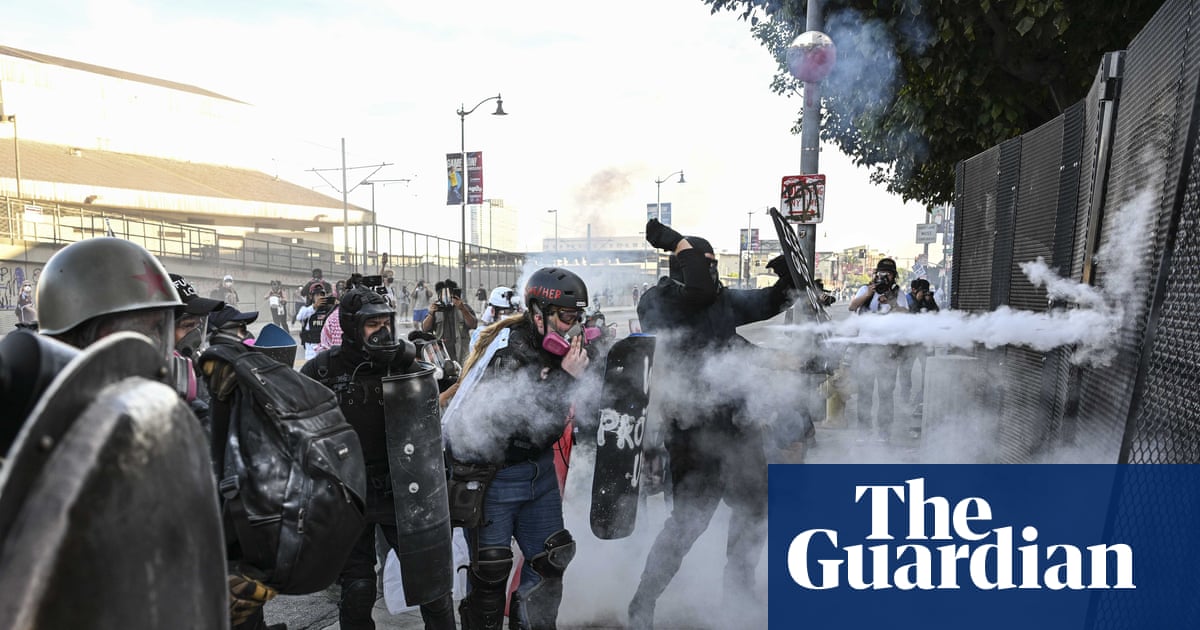
Dozens of people were arrested in Los Angeles after a “No Kings” protest near a federal detention center and other federal facilities escalated into clashes with law enforcement. Coverage across the spectrum agrees that police declared an unlawful assembly after protesters refused orders to disperse, that officers deployed crowd-control measures including tear gas and pepper balls, and that arrests were primarily on failure-to-disperse and related charges. Reports note that the event was part of a broader, internationally coordinated series of “No Kings” actions involving around 150 people locally, with some demonstrators confronting federal agents and local police, and at least one federal building was vandalized with anti-ICE graffiti. Both sides also acknowledge that authorities are reviewing video footage to identify additional suspects beyond those detained on the night of the protest.
Outlets on both sides frame the Los Angeles events within a wider wave of demonstrations against the Trump administration, tying the “No Kings” branding to criticism of executive overreach. They agree that the protests were explicitly political, aimed at decisions by President Donald Trump on immigration enforcement and foreign policy, including conflict with Iran. There is shared recognition that the federal detention center, an ICE-related facility, and Trump-branded properties such as a golf club were focal points, reflecting long-running tensions over immigration raids, detention practices, and presidential war powers. Both liberal- and conservative-leaning sources connect the local unrest to nationwide activist networks and ongoing debates over policing of protests, use of force, and federal authority.
Areas of disagreement
Nature and severity of the protest. Liberal-aligned coverage tends to emphasize that the Los Angeles protest started as a lawful political demonstration with roughly 150 participants, portraying the majority as peaceful and focusing on the point at which police declared an unlawful assembly and used tear gas and pepper balls. Conservative-leaning coverage puts front and center the most extreme acts, highlighting the “KILL YOUR LOCAL ICE AGENT” graffiti, concrete blocks allegedly thrown at federal agents, and descriptions of “rioters” rather than protesters. Liberal reports acknowledge clashes and some vandalism but describe them more as escalations during crowd dispersal, whereas conservative outlets depict the event as quickly devolving into violent anti-law-enforcement unrest.
Responsibility and blame. Liberal sources largely frame the confrontation as a product of aggressive crowd-control tactics and a heavy law-enforcement posture, questioning whether police escalated by moving in on a dispersing crowd and by deploying chemical agents. Conservative sources cast blame primarily on demonstrators and organizers, arguing that slogans targeting ICE and attacks on federal agents show deliberate provocation and contempt for the rule of law. While liberal coverage notes counter-protest tensions and broader anger at Trump policies as contributing factors, conservative outlets stress that protest leaders and radical elements bear responsibility for turning a political rally into what they label a riot.
Characterization of law enforcement response. Liberal-leaning accounts scrutinize the police and federal response, drawing attention to tear gas, pepper balls, and riot-control tactics, and raising questions about proportionality given the size of the crowd and the nature of the offenses. Conservative coverage is more likely to describe the response as necessary or restrained under the circumstances, emphasizing that officers were allegedly targeted with concrete blocks and operating near sensitive federal facilities. Liberal pieces often underscore the civil liberties dimension and potential overreach in declaring an unlawful assembly, while conservative pieces highlight the statutory basis for failure-to-disperse arrests and the need to protect officers and property.
Underlying political framing. Liberal sources situate the “No Kings” protests within broader critiques of Trump’s immigration and foreign policy, stressing opposition to family separations, ICE enforcement, and war with Iran, and presenting the demonstrations as part of a pro-democracy, anti-authoritarian movement. Conservative sources portray the same branding as evidence of radical anti-Trump and anti-state sentiment, linking it to left-wing activism that they say vilifies law enforcement and undermines national security. Liberal outlets see the protests as a legitimate response to executive overreach and human-rights concerns, whereas conservative outlets frame them as symptomatic of a disrespectful, sometimes anarchic, resistance culture.
In summary, liberal coverage tends to foreground protester motivations, civil liberties concerns, and potential over-policing, while conservative coverage tends to emphasize violent incidents, anti-law-enforcement rhetoric, and the necessity of a firm law-and-order response.